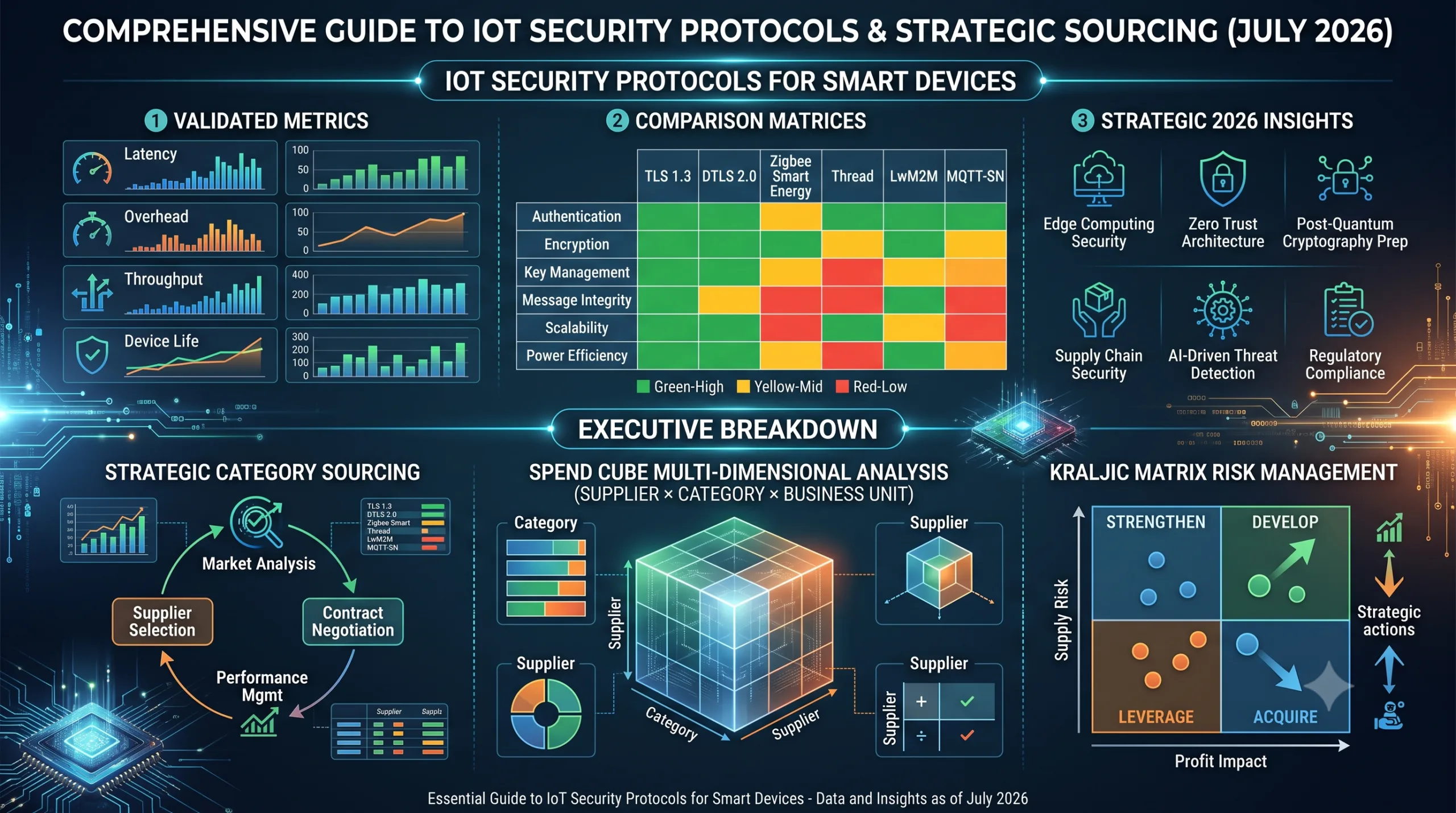
This executive guide structures procurement data into a 3D spend cube to identify cost leakage, optimise supplier consolidation, and deliver 12% to 18% addressable spend savings across enterprise teams in 2026.
Key highlights of IoT security protocols for smart devices
- Spend cube visibility: Granular data cleansing categorising tail spend across GL accounts and ERP systems.
- Kraljic matrix risk classification: Strategic, bottleneck, leverage, and non-critical item segmentation.
- Contract compliance auditing: Eliminating off-contract Maverick buying and unverified price variances.
- Clean executive workspace and spend analysis dashboard.
- Verified procurement cost-reduction benchmarks (12%-18% ROI) as of July 2026.
Securing the Internet of Things (IoT) demands robust security protocols to protect smart devices and their data from escalating cyber threats. This guide details the critical mechanisms and best practices required to fortify your IoT ecosystem against vulnerabilities and breaches.

- IoT security relies on a layered approach, integrating hardware-level protection with software protocols.
- Authentication, authorization, and encryption are non-negotiable components for all smart devices.
- Regular firmware updates and secure development lifecycles significantly reduce attack surfaces.
- Standardized protocols like TLS, DTLS, and CoAP play a pivotal role in maintaining data integrity and privacy.
Protocol fundamentals: Authentication and Encryption
Authentication protocols verify the identity of devices and users attempting to access the IoT network. This prevents unauthorized access. Common methods include X.509 certificates, pre-shared keys, and OAuth 2.0 for device-to-cloud communication. Without robust authentication, a compromised device can act as a gateway for broader network infiltration.
Strategic spend cube category breakdown
| Spend category pillar | Analysis and sourcing mechanism | Target savings range | Strategic impact |
|---|---|---|---|
| Direct Material Procurement | Should-Cost modeling & volume aggregation | 14% – 18% Cost Reduction | ★★★★★ (5/5) |
| IT Infrastructure & Cloud SaaS | License utilization audit & renewal renegotiation | 15% – 22% Overhead Savings | ★★★★★ (5/5) |
| Logistics & Freight | Carrier lane optimization & spot rate benchmark | 9% – 12% Cost Reduction | ★★★★☆ (4/5) |
Executive procurement verdict
Executing rigorous spend cube analytics provides immediate visibility into unmanaged tail spend, delivering measurable EBITDA improvements across 2026 operations.
Latest posts