Key headings
Key highlights on the year 2038 problem
- The Year 2038 problem is real but it is no longer the software crisis many people think it is. Modern operating systems have already implemented major fixes for the Year 2038 (Y2038) bug.
- The remaining challenge lies in legacy hardware, embedded devices, industrial systems, and older software that still depends on 32-bit timestamps.
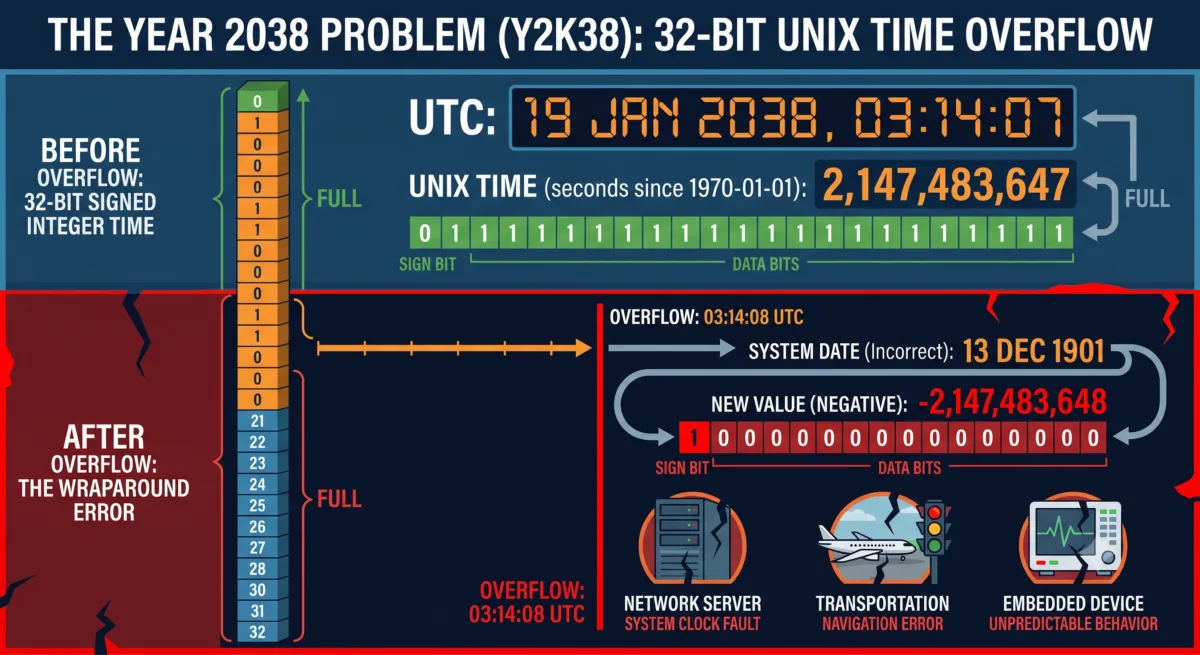
- The Year 2038 problem occurs when systems using signed 32-bit Unix timestamps overflow at 03:14:07 UTC on January 19, 2038.
- Linux kernel 5.6 and glibc 2.34 introduced 64-bit time support for compatible systems, but older embedded devices, legacy databases, and outdated filesystems still require upgrades before 2038.
- Legacy hardware and embedded infrastructure remain the biggest challenge.
- Learn which systems are safe today and which still require remediation.
- Unix timestamps overflow at 03:14:07 UTC on January 19, 2038.
- Modern 64-bit hardware alone does not guarantee protection if legacy 32-bit applications remain.
- Linux kernel 5.6, glibc 2.34, and Debian’s t64 transition significantly reduced software risk.
- Embedded devices, industrial controllers, medical equipment, and older filesystems remain the highest-risk environments.
What is the year 2038 problem?
Many Unix-based operating systems measure time as the number of seconds that have elapsed since January 1, 1970, known as the Unix Epoch. Older systems store this value using a signed 32-bit integer. The largest value this format can represent is 2,147,483,647 seconds, which corresponds to 03:14:07 UTC on January 19, 2038. One second later, the integer overflows into a negative value, causing affected software to interpret the date as December 13, 1901. This can break applications that depend on accurate timestamps, including scheduling systems, databases, logging, authentication, and industrial automation.
Why are modern computers mostly safe?
The widespread adoption of 64-bit processors and operating systems dramatically reduced the impact of Y2038.
Major milestones
- Linux Kernel 5.6 (2020) introduced 64-bit time support for compatible 32-bit systems.
- glibc 2.34 (2021) added _TIME_BITS=64, allowing developers to compile 32-bit software using 64-bit timestamps.
- Debian 13 “Trixie” (2025) completed a large-scale t64 ABI transition, rebuilding thousands of packages to support 64-bit time.
- Running a modern operating system is not enough.
- Legacy 32-bit applications that have not been rebuilt can still experience timestamp overflows even on modern hardware.
Where the risk still exists: Risk area
Why it matters?
- Embedded systems: Long hardware lifecycles and limited firmware updates. Industrial controllers often remain deployed for decades
- Medical equipment – Difficult certification process delays updates
- Legacy databases – Fixed 32-bit date fields can overflow
- Older file– systemsext4 with 128-byte inodes remains vulnerable
- Proprietary software – Many legacy applications cannot be recompiled
- Modern file systems such as Btrfs and ZFS already use 64-bit timestamps, while ext4 requires 256-byte inodes for long-term compatibility.
- Practical advice for IT teams: Organizations responsible for long-lived infrastructure should begin planning now rather than waiting until 2038.
Recommended actions
- Audit all remaining 32-bit hardware.
- Verify that applications use 64-bit time_t.
- Upgrade legacy ext4 filesystems where appropriate.
- Test long-lived X.509 certificates beyond 2038.
- Request written Y2038 compliance statements from equipment vendors.
- Include Y2038 readiness in future hardware procurement policies.
- Planning hardware replacement during normal lifecycle upgrades is usually far less expensive than emergency remediation.
Expert opinion
The Year 2038 problem should no longer be viewed as an ignored software bug. Most major Linux components and modern operating systems already provide the technical foundation needed to operate safely beyond 2038. The remaining challenge is physical infrastructure. Organisations that still depend on embedded devices, industrial controllers, legacy databases, or outdated filesystems should begin inventory and modernisation projects well before the deadline. For most enterprises, Y2038 is now an infrastructure management issue rather than a software engineering emergency.
Frequently Asked Questions
What exactly causes the Year 2038 problem?
The Year 2038 problem occurs because some systems store Unix time as a signed 32-bit integer. When the counter reaches its maximum value at 03:14:07 UTC on January 19, 2038, it overflows into a negative number, causing the system to interpret the date as December 13, 1901.
Are 64-bit computers completely immune?
Not always. Modern hardware is generally safe, but legacy 32-bit applications or libraries can still experience Y2038 issues unless they have been rebuilt to use 64-bit time representations.
How did Debian 13 “Trixie” help?
Debian 13 introduced a major t64 ABI transition, rebuilding thousands of software packages to use 64-bit timestamps and replacing legacy logging systems with modern alternatives.
Can software fail before 2038?
Yes. Applications that generate long-term schedules or certificates extending beyond January 2038 can already expose Y2038-related bugs if they rely on older 32-bit time handling.
YIs the ext4 filesystem vulnerable?
It depends on how it was created. Older ext4 filesystems using 128-byte inodes remain vulnerable, while 256-byte inode configurations support extended timestamps that remain valid until approximately the year 2514.
Latest posts
