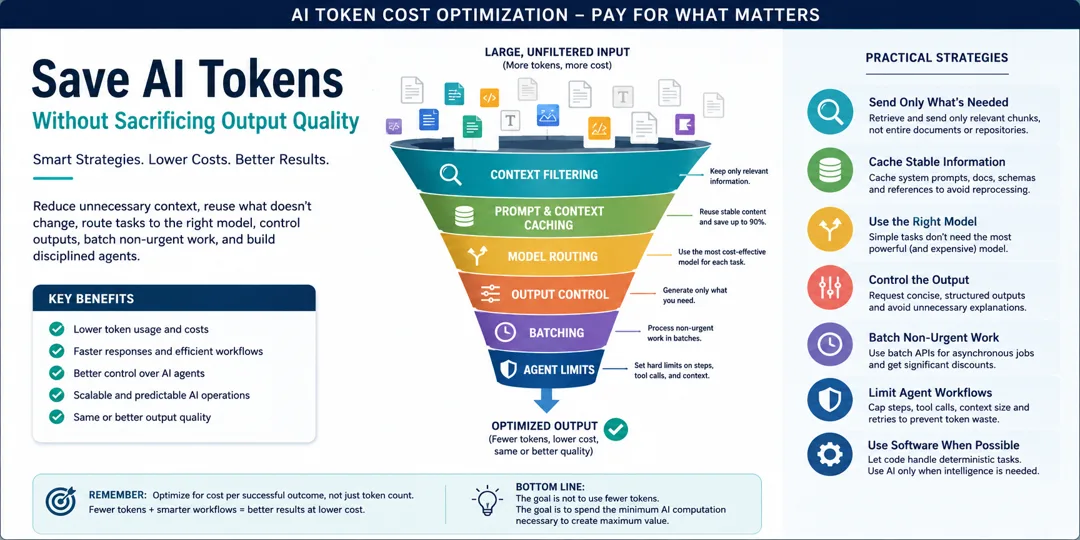
How to save AI tokens
AI can become expensive surprisingly quickly
The problem is often not the price of the AI model itself. Considering the cost of each tokens, options to save the AI tokens is crucial in this era of high AI models use in day to day tasks for IT professionals and freelancers. It is the amount of unnecessary work your application asks the model to perform. Every request can consume input, output, cached and reasoning tokens. Tool calls, repeated context, retries and multiple agent steps can increase the bill even further. The good news is that most token waste can be reduced without sacrificing output quality.
What actually makes AI expensive?
A simple request may require only one model call. An AI agent, however, may understand the task, search for information, call tools, inspect results, reason again, retry and finally produce an answer. A useful way to think about AI cost is:
Total AI cost = model usage + repeated calls + tool costs + retries + infrastructure costs
That is why reducing tokens in one prompt is not always the biggest opportunity. Reducing unnecessary work across the entire workflow can deliver much larger savings.
1. Send only the context the AI needs
This is usually the best place to start. If a 100,000-token documentation set contains the answer in three paragraphs, sending the entire document is unnecessary. Instead:
Index → retrieve → filter → send relevant content → generate
The same applies to software development. Give a coding AI the relevant function, interface, error message, failing test and recent code changes instead of repeatedly sending the entire repository. A large context window is a capability not a reason to fill it.
2. Cache information hat does not change
Many AI applications repeatedly send the same system instructions, documentation, schemas, policies or reference material. Keep stable information together and place changing user information afterwards:
Stable context → cached context → new user request
When supported by the provider, caching can substantially reduce the cost of repeatedly processing the same input. The exact discount, cache duration and pricing rules vary by provider and model, so current documentation should be checked before implementation.
3. Use the right model for each job
You do not need your most powerful reasoning model for every task. The goal is not to always use the cheapest model. It is to use the least expensive model that reliably meets your quality requirement.
- Task → Better approach
- Classification → Small/fast model
- Simple extraction → Small/fast model
- Formatting → Small/fast model
- Summarisation → Small/medium model
- Routine coding → Medium model
- Complex debugging → Strong reasoning model
- High-risk verification → Strong model + human review
4. Control the output
Developers often focus on reducing input while ignoring generated output. If your application needs five JSON fields, do not request a long explanation first. If you need one classification, ask for one classification. Structured outputs can reduce unnecessary text and make downstream processing easier. This becomes especially important when the same workflow runs thousands or millions of times.
5. Match reasoning to the task
Not every problem deserves maximum reasoning effort. Extracting an invoice number is fundamentally different from diagnosing a complex distributed-system failure. Use deeper reasoning where it adds measurable value and avoid spending expensive reasoning resources on routine operations.
6. Batch work that does not need an instant answer
Non-urgent workloads such as document classification, bulk extraction, dataset enrichment, evaluations, content analysis and nightly processing can often be handled through discounted batch processing. If the user does not need an immediate response, paying a real-time processing premium may not make economic sense.
7. Put hard limits on agents to save AI tokens
Agents can become the biggest source of token waste. An agent may search repeatedly, read large pages, call unnecessary tools, receive oversized results, reason again and retry. The individual steps may appear reasonable, but together they create workflow multiplication. A bounded agent is usually easier to control, evaluate and price than an unlimited autonomous workflow. Set limits for:
• Maximum model calls
• Maximum tool calls
• Retrieved documents
• Context size
• Output length
• Retries
• Runtime
• Escalation conditions
8. Make tool results smaller
Tools also consume context. Do not expose dozens of tools when an agent needs only a few. Return the three fields required for a decision instead of an entire database record. Avoid sending complete webpages, verbose logs or unnecessary metadata when a concise structured result is sufficient.
9. Compress conversation state
Long-running agents can become expensive because every new request carries an increasingly large history. Instead of replaying everything:
Raw history → summarised state → relevant recent context
Store durable information such as decisions, current status, known errors and changed files in application storage. The model should receive only the information required for the current task.
10. Use software where AI is not necessary
One of the most overlooked savings is eliminating AI calls. Use ordinary software for arithmetic, database queries, authentication, permission checks, date calculations, validation, fixed business rules, string matching and deterministic transformations. Use AI when language understanding, probabilistic reasoning or other genuinely intelligent behaviour is required.
Cost per successful result
Do not optimise for token count alone. Suppose you reduce tokens by 50%, but the system becomes less accurate and requires additional retries or human corrections. Your actual costs may increase. This includes model usage, tools, retries and human correction where applicable.
The better metric is Cost per successful outcome = Total workflow cost ÷ successful results
The smart 80/20 order optimised for most AI applications
1. Remove unnecessary context
2. Stop repeating stable information
3. Use caching
4. Constrain output
5. Route simple tasks to economical models
6. Limit agent loops and tool results
7. Batch non-urgent workloads
8. Measure cost per successful task
9. Only then consider sophisticated compression or specialised optimisation
The strongest optimisation may be even simpler: eliminate work that does not need to happen. If the same expensive analysis can be generated once and reliably reused, there may be no reason to run the model repeatedly.
Final takeaway to save AI tokens
Saving AI tokens is not about making every prompt unnaturally short. It is about building smarter systems. Read only what is relevant. Remember only what matters. Cache what repeats. Use the right model. Generate only what is required. Limit autonomous work. And eliminate AI calls whenever ordinary software can do the job. The real goal is not simply to use fewer tokens. It is to spend the minimum AI computation necessary to produce a reliable result worth more than its cost.
Related posts
