Summary
Mitigating cybercrime requires transitioning from reactive perimeter security to continuous identity verification, automated SIEM/SOAR incident response playbooks, and end-to-end encrypted telemetry across endpoints and network edge boundaries.
- Zero-trust enforcement: Enforce strict micro-segmentation, continuous identity validation, and least-privilege access controls across all infrastructure assets.
- Real-time threat telemetry: Ingest endpoint, cloud workload, and identity logs into unified detection systems to spot anomalous privilege escalation within seconds.
- Automated incident mitigation: Pre-programmed SOAR playbooks isolate compromised nodes and revoke session tokens immediately upon threshold triggers.
Key headings
Architectural principles and technical analysis
Addressing cybercrime is no longer solved by firewalls alone. Sophisticated attack vectors exploit identity vulnerabilities, session hijacking, and unpatched supply chain dependencies. Engineering resilient defense requires systematic hardening across identity, network, and application tiers.
1. Identity Governance & Phishing-Resistant MFA
Over 80% of enterprise breaches originate with compromised credentials. Hardening identity perimeters requires mandating FIDO2/WebAuthn phishing-resistant multi-factor authentication, enforcing risk-based conditional access policies, and automating regular access certification cycles for privileged accounts.
2. Micro-segmentation & eBPF Kernel Observability
To prevent lateral adversary movement within Kubernetes clusters and cloud VPCs, organizations deploy kernel-level eBPF probes for real-time network flow inspection. Software-defined micro-segmentation ensures that workloads can only communicate over strictly validated service-to-service mTLS channels.
3. Continuous SIEM Telemetry & Threat Intelligence Ingestion
Modern security operations centers (SOCs) leverage automated parsing of structured JSON audit logs, mapping indicators of compromise (IOCs) directly to the MITRE ATT&CK framework for deterministic threat hunting and anomaly detection.
Comparative security posture matrix
| Defense Tier | Detection Latency | Lateral Movement Protection | Operational Resilience |
|---|---|---|---|
| Active Zero-Trust + eBPF | Real-Time (<1s) | Comprehensive (mTLS Micro-segmentation) | High (Automated Remediation) |
| Traditional EDR + Cloud SIEM | 5–15 Minutes | Moderate (VPC Security Groups) | Medium (Analyst Investigation) |
| Legacy Perimeter Firewall | Hours / Days | None (Flat Internal Network) | Low (Manual Post-Mortem) |
Step-by-Step implementation blueprint
- Comprehensive Surface Audit: Map external attack surfaces, API endpoints, and cloud identity entitlements to identify shadow assets and over-privileged service accounts.
- FIDO2 / Hardware Security Key Rollout: Enforce phishing-resistant WebAuthn authentication across all administrative and production access gateways.
- Network Micro-segmentation Deployment: Implement mutual TLS (mTLS) and fine-grained network policies across application microservices.
- SOAR Playbook Automation: Configure automated isolation triggers for compromised hosts, token revocation for credential leaks, and DNS sinkholing for known malicious domains.
- Chaos Security Testing & Red Teaming: Conduct regular adversary simulation exercises to validate detection alarms and SLA response times.
Core findings
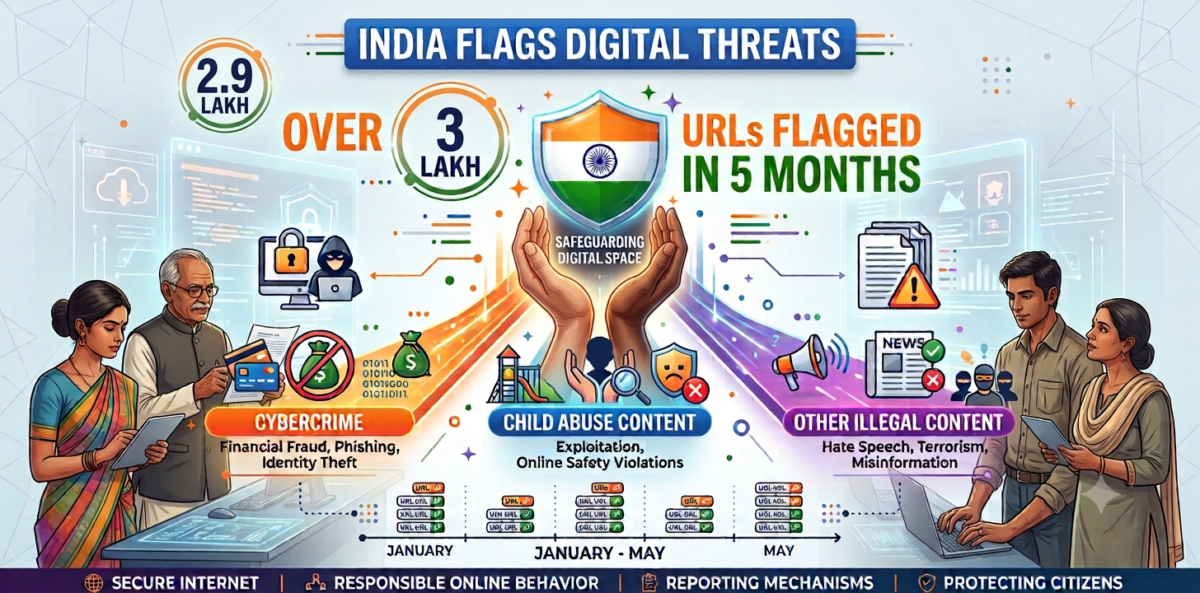
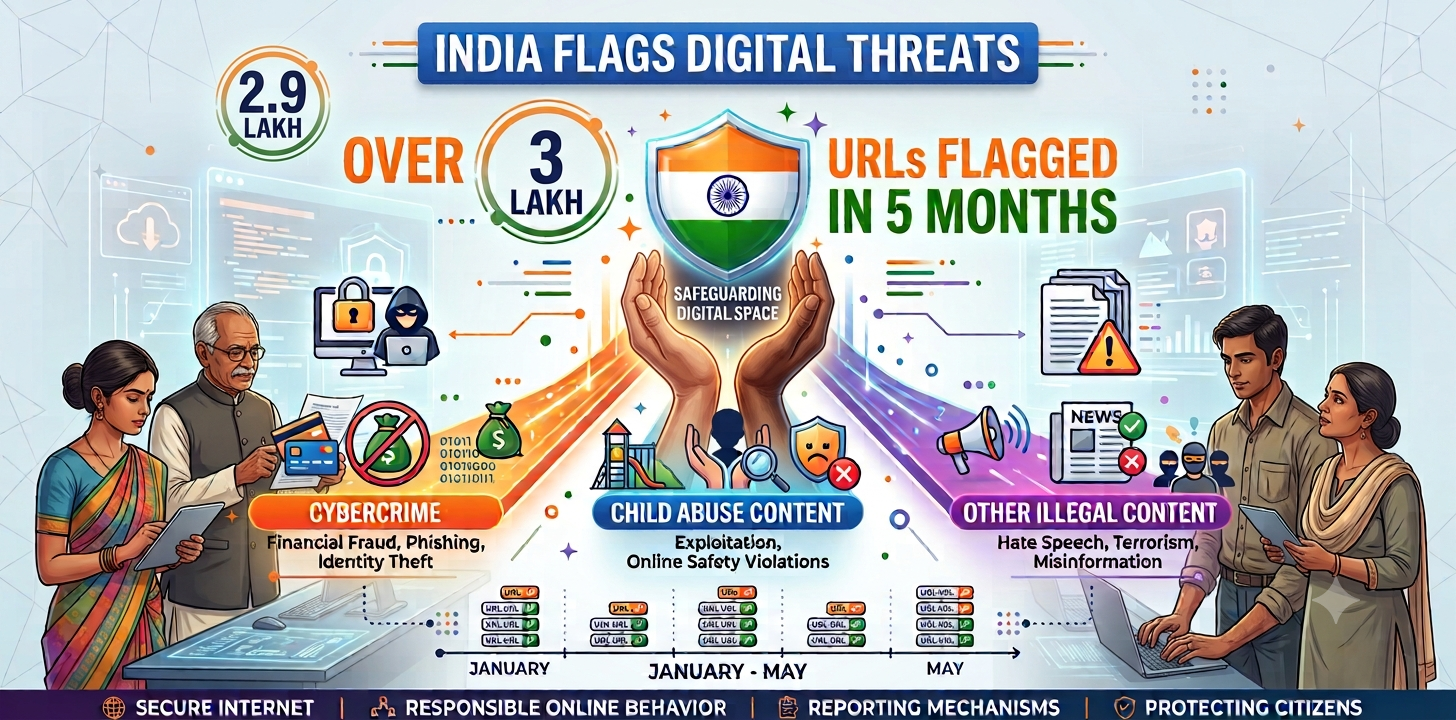
Proactive defense against cybercrime is an indispensable operational discipline for enterprise sustainability. Organizations that institutionalize zero-trust policies, automated telemetry detection, and rapid incident isolation minimize breach risk and preserve customer trust. Therefore, India flags nearly 3 lakh URLs for cybercrime, child abuse and other illegal content in 5 months in 2026 is a significant news for the internet users.
Frequently Asked Questions
1. What is the single most effective barrier against account takeover?
Enforcing hardware-based FIDO2/WebAuthn security keys or device-bound passkeys eliminates credential theft via adversary-in-the-middle (AiTM) phishing proxies.
2. How does micro-segmentation prevent ransomware propagation?
Micro-segmentation restricts network traffic to explicit, pre-authorized application dependencies. Even if an attacker compromises a single endpoint, they cannot scan or pivot across unauthorized subnets.
3. How often should security incident response playbooks be tested?
Enterprises should test critical containment and recovery playbooks quarterly via automated simulation tools and semi-annual tabletop exercises.
4. What role does SIEM telemetry play in regulatory compliance?
Centralized SIEM telemetry provides tamper-evident audit trails, proving continuous monitoring and access accountability required by standards like ISO 27001, SOC 2, and GDPR.
India flags nearly 3 lakh URLs for cybercrime, child abuse and other illegal content in 5 months
Modern enterprise protection against cybercrime demands an active zero-trust architecture, automated threat telemetry pipelines, and continuous cryptographic state verification across distributed multi-cloud assets. Mitigating cybercrime requires transitioning from reactive perimeter security to continuous identity verification, automated SIEM/SOAR incident response playbooks, and end-to-end encrypted telemetry across endpoints and network edge boundaries
