Master AI traceability to prevent failures and ensure reliable modelsas the ultimate solution to model failures
Key headings
As organizations deploy complex neural networks to automate decisions, they face a silent but devastating vulnerability: the black-box problem. When an algorithm behaves unpredictably, the lack of transparency triggers an operational crisis. This is where implementing AI traceability becomes the ultimate solution to avoid model failure.
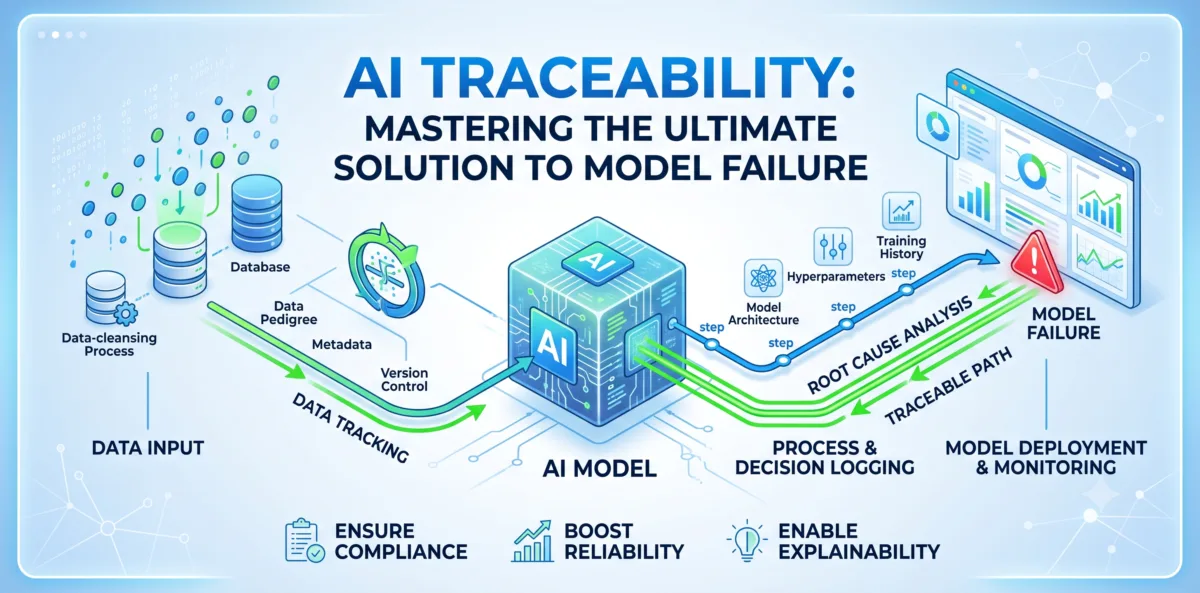
AI traceability refers to the capability to track the origin, development history, training datasets, metadata, hyperparameters, and operational decision paths of an artificial intelligence model. It provides an auditable paper trail key for regulatory compliance (like the EU AI Act), model debugging, bias identification, and system security.
Without clean traceability protocols, developers struggle to locate data corruption, track parameter drift, or defend their systems during compliance audits. Establishing an end-to-end trace history enables teams to identify vulnerabilities, eliminate bias, and prevent system-wide crashes before they affect users.
The critical components of an auditable AI system
To defend your pipelines against operational drift and compliance failures, your traceability framework must track three core dimensions. These dimensions are helpful for data lineage, avoiding configuration mismatches and enabling live tracing of incidents, while implicating the trained data and set rules in a model.
1. Dataset lineage and provenance tracking
If your training data contains biased, copyrighted, or corrupted entries, your model is doomed to fail. Traceability maps the complete lineage of your datasets documenting every ingestion step, preprocess transform, and split hash. This guarantees that your training inputs are clean, auditable, and fully reproducible.
2. Hyperparameter and model heritage
Modern training pipelines are highly sensitive to small adjustments. Traceability logs record the repository commit hash, CPU/GPU system environment specs, training seed values, and specific hyperparameters (learning rates, loss functions, epoch splits) utilized. Linking the compiled model binary directly to its unique training heritage prevents configuration mismatches during deployment.
3. Real-time explainability and inference auditing
In production, models process active user inputs. Audit logs capture the telemetry vectors, model versioning tags, and explanation metrics (such as SHAP values or feature attention grids) for every decision. Having this trail is vital when responding to user challenges or regulatory complaints.
Conquering the EU AI Act compliance mandate
AI traceability is no longer optional; it is a strict legal requirement under the new EU AI Act. High-risk systems deployed in critical industries must comply with automated validation criteria:
Automated Event Logging: High-risk tools must generate runtime logging trails to identify security incidents, trace decision logic, and manage model drift.
Thorough Technical Documentation: Audits demand a complete history of the design specifications, validation metrics, and dataset sources.
Bias Prevention Audits: Teams must prove that training datasets are representative, free from structural skew, and actively monitored for fairness metrics.
Implementing the ultimate traceability architecture
Establishing AI traceability without slowing down your deployment pipeline requires adopting modern, structured metadata architectures:
Unified Model Registry: Never push models directly to production. Tag every artifact in a model registry (like MLflow) and map it back to its specific training run.
GitOps Configuration Management: Track all configurations, Docker container templates, and environment scripts in Git.
WORM Audit Logging: Save inference telemetry logs to Write-Once-Read-Many (WORM) storage. This prevents tampering and ensures your audit trail is fully verified and tamper-proof.
By investing in robust traceability tools, organizations can debug models in minutes, defend their decisions against regulatory scrutiny, and build authentic trust with their end-users.